The probabilities that are going to shape the EHF EURO 2026
Throughout the course of the Men’s EHF EURO 2026, data analyst Julian Rux will provide the handball community with deep insights into the numbers behind the game, analysing what the data says about teams’ and players’ performances. To begin with, he looks at the teams’ chances for the tournament ahead.

In football, chance plays a much bigger role than in other sports. The underdog wins games much more often than in high-scoring games such as handball. Expected goals are a good indicator here of who was actually the better team, more than the actual result. Studies have shown multiple times that assessing teams after their results by xG is a much better predictor for future success than their actual results.
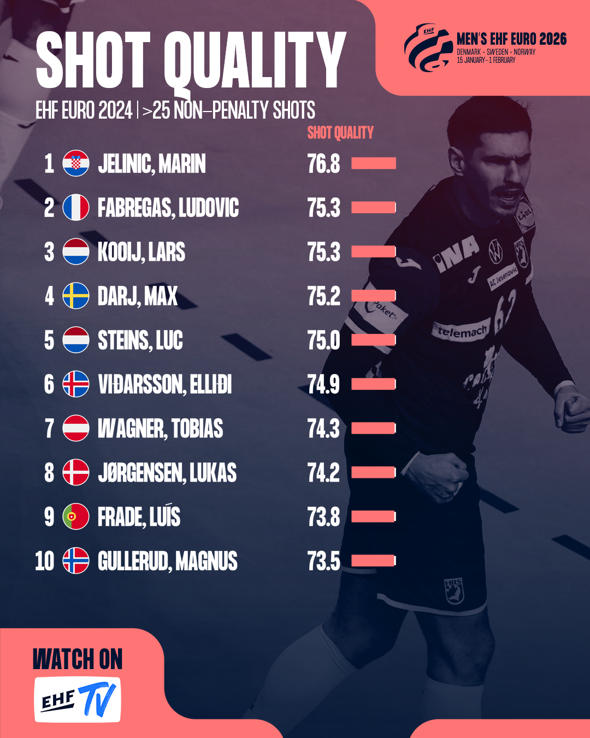
In handball, this is a bit different. Because of the high-scoring nature of the sport, the raw xG value is less meaningful. But still, numerous very interesting insights can be derived from xG. For example, the average of all xG values from all shots shows the quality of shots. It shows whether a team or player is able to get high quality or rather difficult attempts.
At the EHF EURO 2024 the Netherlands had the best shot quality with 67.8 per cent and were great in attack in general. Their playmaker Luc Steins stood out in particular. He did not only set up countless good chances but also had by far the best shot quality of all the backcourt players. Excluding penalty throws, only four wing players and line players were better than Steins. The second-placed backcourt player was Dane Mathias Gidsel in 20th place.
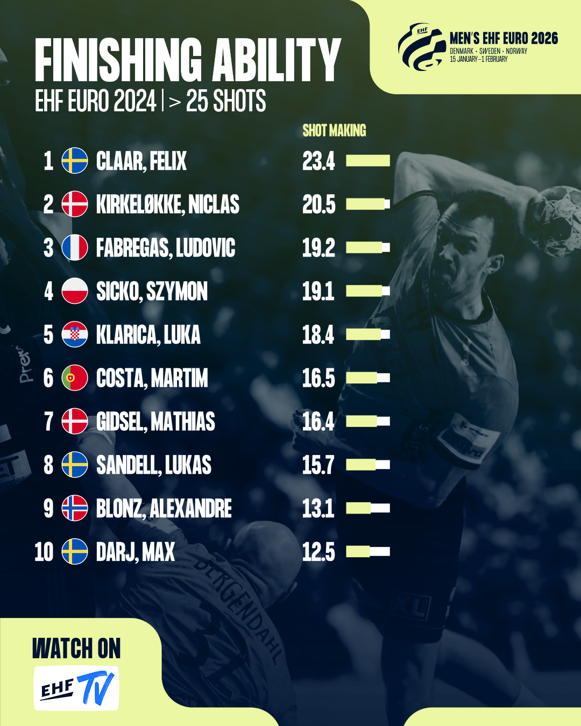
A second possibility is to look at the finishing ability or shot making, which both is just the overperformance of xG by actual goals. Interestingly, Spain performed best here two years ago with 6.1 per cent more goals than expected, but had big problems in defence.
Sweden’s Felix Claar played a great tournament two years ago as he ranks first here with 23.4 more goals than expected. It also shows Mathias Gidsel’s greatness, as he is the only backcourt player that ranks in the top 20 in both shot quality and shot making, something he regularly does in the German Bundesliga as well. Overall, just five players scored, percentage wise, more than expected than the Danish right back.
The model used here and for analysis during the whole EHF EURO 2026 includes more than 100,000 shots with data that includes the distance and angle of the shot, the position of the goalkeeper, the hand of the shooter, the type of shot and the pressure on the shooter.
Winning probabilities
Based on xG, not only individual goals can be looked at but whole games. For example, looking at EHF EURO 2024’s xG shows that based on their shot attempts, France should have won the final by an even bigger margin than they did (33:31), as they accumulated 37.4 xG compared to Denmark’s 29.1 xG. France had nine more attempts, as well as higher quality attempts, with 4.1 percentage points better shot quality, while Denmark made up for this at least in part with 18.3 percentage points better shot making.
And not only that, xG can give us probabilities of how likely each team’s win was by simulating the game based on the xG values — the scoring probabilities of the shots taken. In about 95 per cent of cases, France would then have won the final as well.
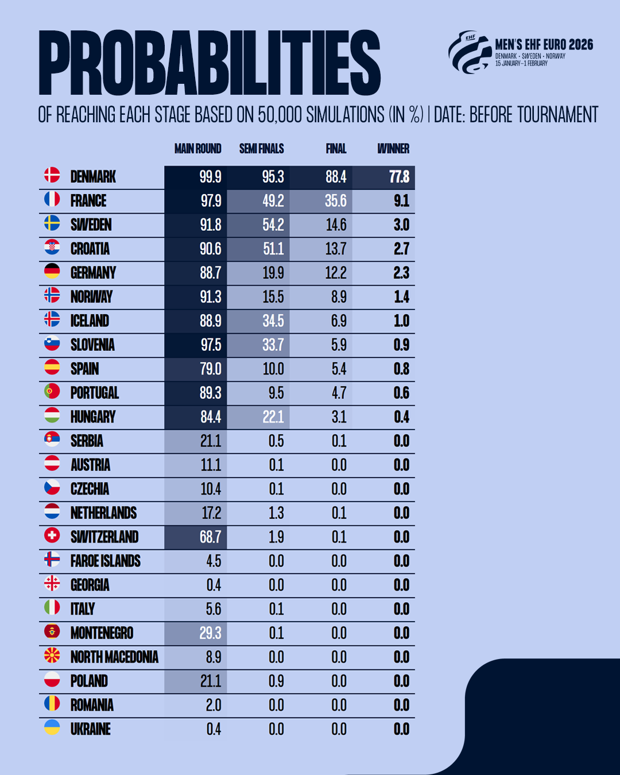
Based on their past results, with gold at both the Paris 2024 Olympic Games and the 2025 IHF Men’s World Championship, it is hardly surprising that the simulations see Denmark as the big favourites. In 77.8 per cent of the simulations they win the title, which means that our model sees the probability of them winning at 77.8 per cent.
The model puts the probability of Nikolaj Jacobsen’s team making it to the final at 88.4 per cent and making it to the semifinal at 95.3 per cent. In just 0.072 per cent of the simulations they were knocked out after the preliminary round.
Even though the gap is very big to Denmark, the team with the second highest probability of winning is France at 9.1 per cent. However, their probability of making it at least to the semifinal is only the fourth highest at 49.2 per cent, thanks to the bracket they are in. All four of the highest-ranked teams according to the Elo ratings — Denmark, France, Germany and Norway — are on the same side of the bracket and will be in main round group I if they survive the preliminary round.
Because of that, Sweden’s (54.2 per cent) and Croatia’s (51.1 per cent) probabilities of making it to the semi-final are higher than France’s, while their probabilities of winning the European championship are lower at 3.0 and 2.7 per cent. But they are still higher than Germany (2.3 per cent) and Norway (1.4 per cent), even though they have lower Elo ratings, because the model sees their side of the bracket as much more difficult than the other.