Decoding Denmark's historic team at the Men's EHF EURO 2026
Throughout the course of the Men’s EHF EURO 2026, data analyst Julian Rux provided the handball community with deep insights into the numbers behind the game, analysing what the data says about teams’ and players’ performances. The series concludes with how Denmark became European champions and tries to find out whether they were the best team at an EHF EURO ever.

The best offence claimed the trophy
Denmark were also the clear favourites going into the final against Germany, even though the match marked the clash between the best attack and the best defence of the tournament — a status the two teams held before the final and still hold now.
To evaluate this fairly, we adjusted the numbers to 50 possessions to compensate for differences in game pace. In addition, the numbers were adjusted to the quality of the opponents played, because in a competition where not everyone plays against the same teams — such as the EHF EURO — the quality of the opponents can heavily influence the stats. The methodology was explained in more detail in the latest article of this series.
These numbers show that Denmark had the best offence of the tournament with 34.1 goals scored per 50 possessions adjusted for the strength of their opponents, while Germany had the best defence with opponent-adjusted 26.3 goals conceded per 50 possessions. What set both teams apart, however, was that in defence Denmark ranked second, just slightly behind Germany with opponent-adjusted 26.5 goals conceded per 50 possessions. Germany’s attack, in contrast, wasn’t on the same level as Denmark’s, as they rank just eighth with 29.3 goals scored per 50 possessions.
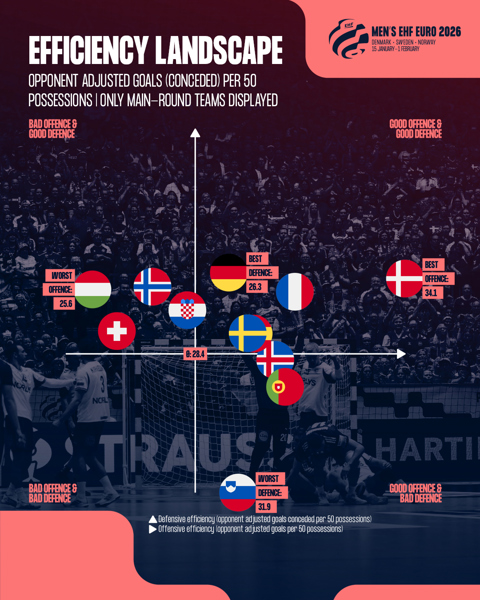
Interestingly, Denmark’s attack was built in a very different way than that of all other teams that made it at least to the main round, with their big focus on two players in attack. MVP Mathias Gidsel and left back Simon Pytlick were responsible for the end of their team’s attack in 50.2 per cent of cases by either shooting from the field, receiving a seven-metre shot or turning the ball over.
No other team had a duo that came close, especially no other team that made it to the main round. The second-placed Georgian duo of Giorgi Tskhovrebadze and Nikoloz Kalandadze had 5.1 percentage points less, while the second-best placed team that made it to the main round — Slovenia’s Blaž Janc and Domen Makuc — was even 8.6 percentage points behind the Danish duo.
Germany’s offensive approach was much broader. Their most used offensive pair of Renārs Uščins and Juri Knorr just ended 35.7 per cent of their team’s attacks. But while Germany’s good defence forced Gidsel and Pytlick to their worst shooting performance of the tournament at just 57.7 per cent combined (15/26) — the second worst was in the first match against Germany with 61.5 per cent — Germany’s back court couldn’t make use of it. Their most used back court trio in the final — Renārs Uščins, Juri Knorr and Julian Köster — shot just 44.0 per cent (11/25).
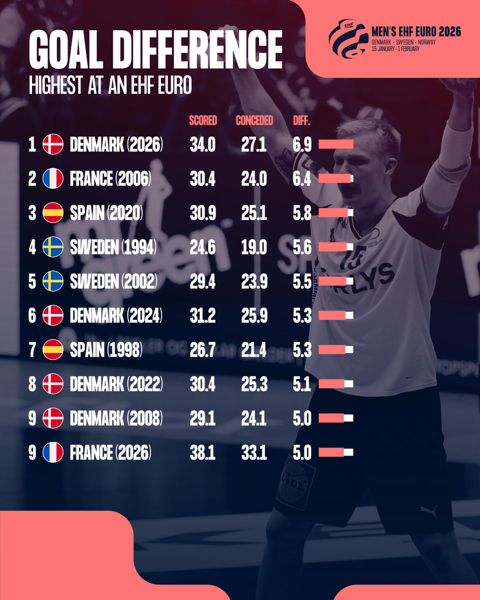
The great attack of Denmark led to the third most goals per game ever scored by a team at an EHF EURO with 34.0. This even put them on par with the previous record holders, France, from two years ago. However, France (38.1) and Portugal (34.2) even scored more at this tournament.
But in combination with their great defence, Denmark set a new record for the highest goal difference per game with +6.9. They surpassed France’s 20-year-old record of +6.4, despite their loss against Portugal and Mathias Gidsel admitting after the final that "maybe we were a bit shaky compared to other events."
The tournament of goal records
That wasn’t the only new record set at the Men’sEHF EURO 2026. Overall, this year’s tournament was the EHF EURO with the most goals per 60 minutes ever, with 31.1. The previous record was set in 2006 with 29.6. So, for the first time ever, the 30-goal barrier was broken.
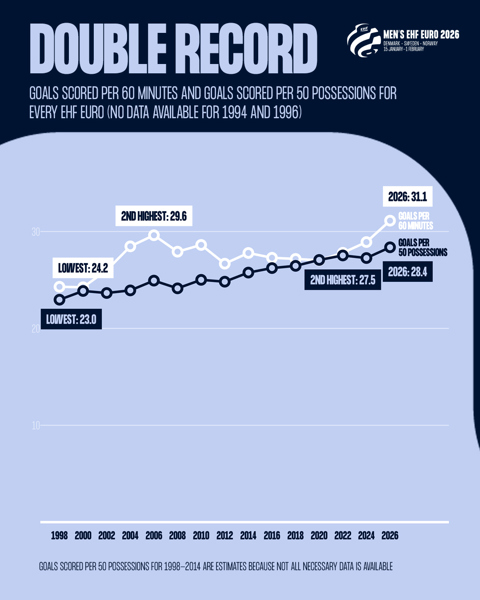
The biggest difference compared to 2006 is that handball has become much more efficient. Since the Men’s EHF EURO 1998, the first tournament where data is available (from 1998 to 2014, possession and pace data are estimates because not all necessary data is available), the efficiency has improved almost with every iteration — from 23.0 goals per 50 possessions in 2016 to 28.4 this year. Here, a new record was set, surpassing 27.5 goals per 50 possessions from 2022.
The comparison of the two curves of goals per 60 minutes and per 50 possessions shows that while the possession-adjusted numbers increased gradually, the minutes-adjusted numbers peaked in 2006, then it decreased until 2020 and increased again since. That’s a clear indicator that the second driver for how many goals are scored besides the efficiency, the pace of the game, has caused this development.
That is precisely the case. In 2006, at the height of the fast throw-off, the pace of the game was the second-highest ever with 59.4 possessions per team per 60 minutes, just 0.1 less than the record two years ago. Since then, the pace has gradually decreased until 2020 when, on average, there were just 50.2 possessions per team per 60 minutes, the fewest ever. No wonder that significantly fewer goals were then scored.
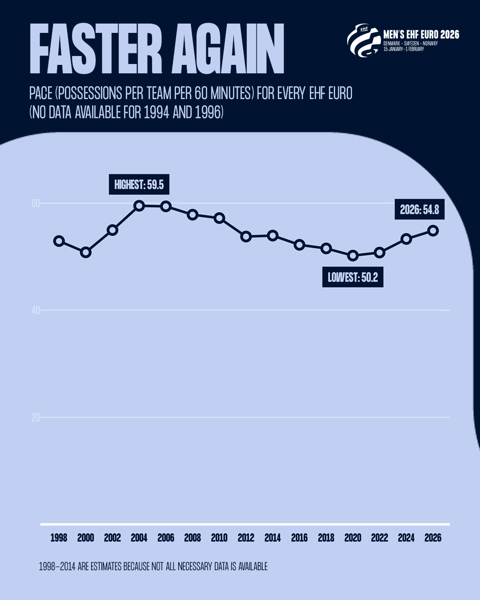
Since the EHF EURO 2022, the pace of the game has become faster again with each iteration. 54.9 possessions per team per 60 minutes at this year’s tournament is the fastest since 2010. Together with increased efficiency, this has produced the highest-scoring EHF EURO ever this year. This also shows why the adjustment per possessions is so important to make the teams actually comparable, despite the high differences in pace.
The best team at an EHF EURO ever?
France’s goal record on team level was heavily influenced by their pace as well. With 61.6 possessions per game, they had the fastest games by a team since 2016 (the first year that data for this is available). In contrast to Denmark, who had about 10 possessions less per game, France lacked efficiency. Hence, adjusted to their opponents' strength and pace, France rank at exactly 3.0 goals scored behind Denmark at the Men's EHF EURO 2026.
The fact that Denmark are the second team in history to become European, World and Olympic champions at once, in addition to their great goal difference, immediately raises the question whether this was the best team ever at an EHF EURO. Opponent and possession-adjusted data to compare the teams fairly only became available in 2016, but since then, no other team came close to Denmark’s 34.1 goals. In fact, the second-best ranked team is France this year.
Since we previously saw that overall efficiency prior to 2016 was significantly lower than it is today, and since the Danes have the best shooting percentage of all time, there is little doubt that this was the best offence ever. Together with Slovenia, they were the first team ever at an EHF EURO that scored on more than 70 per cent of their shots ,with 71.7 per cent, while Slovenia placed at 70.6. The previous record holders were Croatia in 2018 with 69.4 per cent.
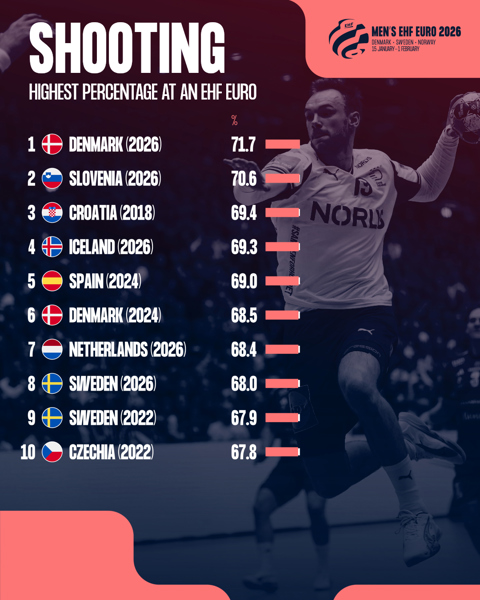
With the rising efficiency, there were of course several teams with better defensive numbers than Denmark since 2016, but there was no team with a better opponent and pace-adjusted goal difference. In fact, they clearly smashed the previous record (after 2016) of +6.0 — set by Spain in 2020 — with +7.6.
France from 2006 rank second regarding the unadjusted goal difference. Since adjusted data from back then is not available on team level, we can’t say for certain if they were better, but since the pace in general was higher than today, this suggests that they might have played very fast as well and thus their adjusted numbers might probably not be better.
Fourth-ranked Sweden from 1994, however, represent a very interesting case. Their raw goal difference of +5.6 was in a time when handball was much slower. But since we don’t even have overall data from 1994, the question whether — by the data — Denmark were the best and most dominant team can probably never be answered.